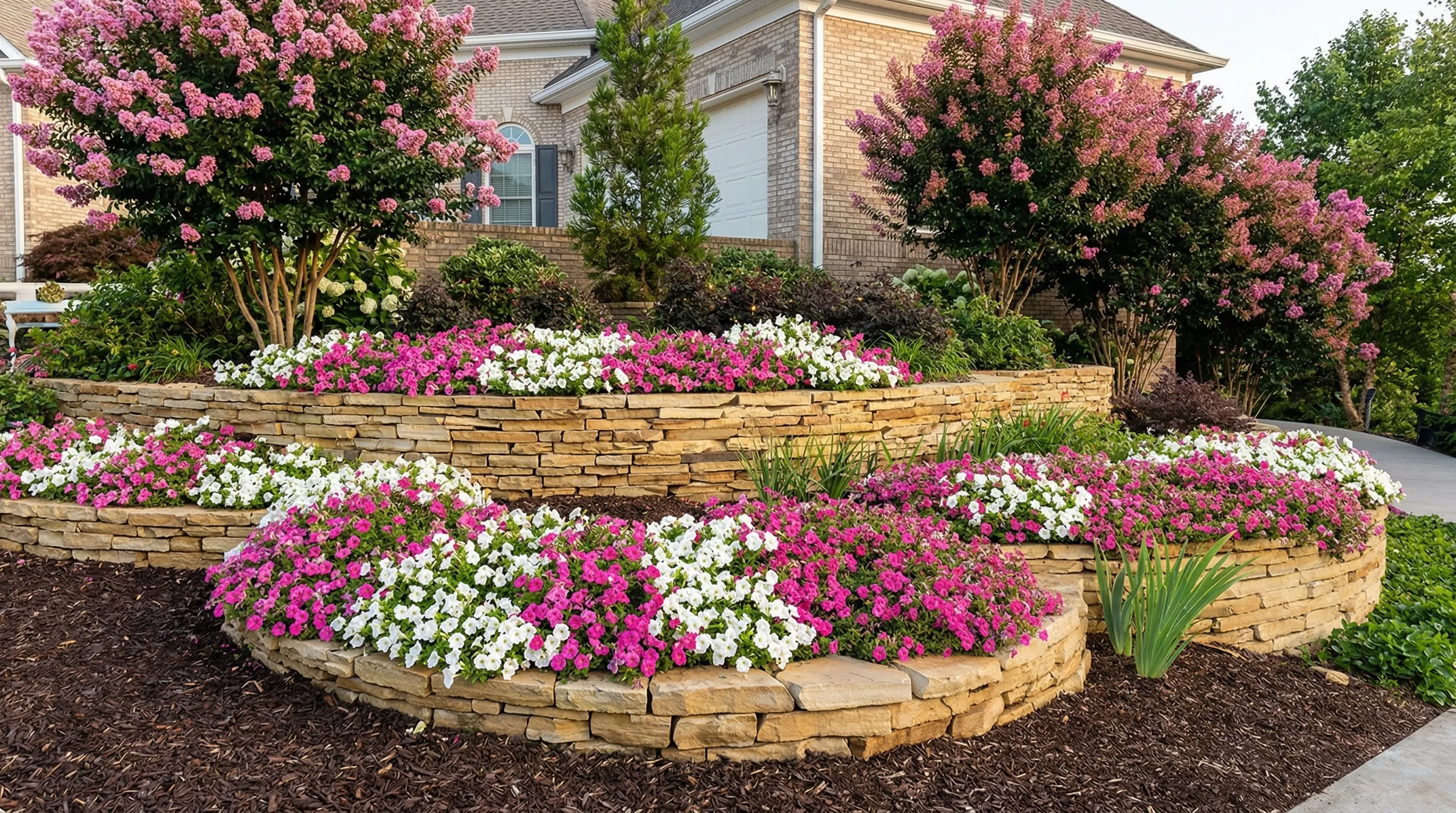
Retaining Walls
Stuart Row Landscapes designs and builds retaining walls for residential and commercial properties across Knoxville and East Tennessee. In a region defined by rolling hills and clay-heavy soil, retaining walls aren’t just decorative — they’re essential infrastructure that manages grade changes, prevents erosion, and creates usable outdoor space.
What We Build
- Natural stone walls — dry-stacked Tennessee fieldstone and boulder walls for a naturalistic look
- Segmental block walls — engineered interlocking systems for structural applications
- Terraced wall systems — multiple tiers that create planting terraces on steep grades
- Seat walls — low decorative walls that double as seating around patios and fire features
- Garden walls — raised beds and borders that define planting areas
- Boulder walls — large native boulders placed to hold grade with a rugged, natural aesthetic
Why Retaining Walls Matter in East Tennessee
Knoxville sits in the Ridge and Valley region of the Appalachians. The terrain is rarely flat. Properties in West Knoxville, Farragut, and the surrounding counties routinely deal with:
- Significant grade changes — 5 to 15+ foot elevation differences across a single lot
- Clay soil — East Tennessee’s red clay expands when wet and contracts when dry, creating pressure on wall structures
- Heavy rainfall — the Knoxville area receives about 47 inches of rain annually, making drainage critical
- Freeze-thaw cycles — winter temperatures regularly cross the freezing point, stressing poorly built walls
These conditions mean retaining walls in this region must be engineered for the specific site — not built from a generic plan.
How We Build Retaining Walls
Every Stuart Row retaining wall follows a process designed for long-term structural performance:
- Site assessment — evaluate grade, soil type, drainage patterns, and surcharge loads (driveways, structures above the wall)
- Design — wall height, setback, batter angle, and reinforcement calculated for the specific conditions
- Excavation — proper footing depth below frost line and undisturbed soil
- Drainage system — perforated pipe at the base, drainage aggregate behind the wall, filter fabric to prevent soil migration
- Base preparation — compacted gravel leveling pad for the first course
- Construction — each course checked for level and batter, geogrid reinforcement installed at engineered intervals for walls over 3 feet
- Backfill and grading — proper compaction in lifts, final grading to direct surface water away from the wall
The Part You Don’t See
The most important parts of a retaining wall are invisible once it’s finished. The drainage system behind the wall, the compacted base, the geogrid reinforcement, the properly graded backfill — these are what determine whether your wall looks the same in 20 years or starts leaning in 3.
We don’t take shortcuts on the structural work. It’s the foundation that everything visible sits on.
How much does a retaining wall cost in Knoxville?
+
Retaining wall costs in Knoxville depend on wall height, length, material, and site conditions. Taller walls require engineered designs with geogrid reinforcement, which adds cost but is non-negotiable for structural integrity. We provide detailed estimates after a site visit where we can assess the grade, soil conditions, and drainage requirements.
How tall can a retaining wall be?
+
Single-tier retaining walls are typically built up to 4 feet. For greater height changes, we use terraced walls — multiple shorter walls with planted terraces between them. This approach is more stable, looks more natural, and creates planting opportunities. Walls over 4 feet require engineering and may need permits in Knox County.
What causes retaining walls to fail?
+
The number one cause of retaining wall failure is poor drainage. Water buildup behind a wall creates hydrostatic pressure that pushes the wall forward. Every Stuart Row retaining wall includes drainage aggregate behind the wall, perforated drain pipe at the base, and proper backfill — the invisible work that keeps the wall standing for decades.
Do I need a retaining wall or just a slope?
+
It depends on the grade change, how you want to use the space, and erosion concerns. A gentle slope with groundcover might be fine for a gradual grade. But if you want usable flat space, need to prevent erosion on a steeper grade, or want to create terraced garden beds, a retaining wall is the solution. We'll advise honestly on whether a wall is necessary or if a simpler approach works better.
Ready to get started?
Every project begins with a conversation about your land, your vision, and how you want to live outside.
Start a Conversation