Retaining Wall Ideas That Actually Work in East Tennessee
From natural stone to budget-friendly block, here are retaining wall ideas designed for Knoxville's terrain — with real materials, construction details, and design approaches.
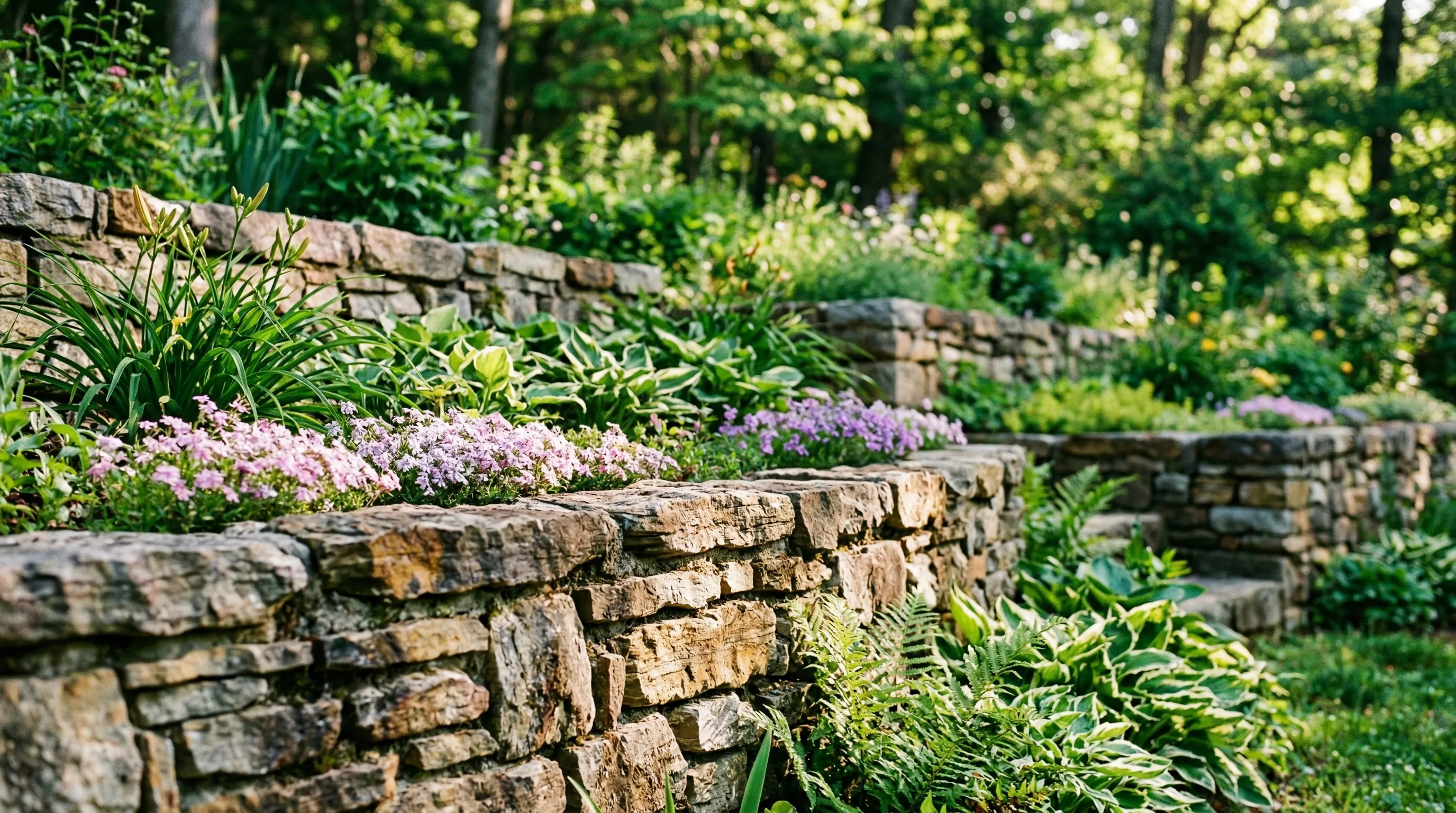
The best retaining wall ideas start with the land you actually have — not a Pinterest board. In Knoxville and across East Tennessee, that means clay soil, rolling grades, and a climate that swings from 95-degree summers to hard freezes. A wall that looks beautiful in a photo but ignores those realities will be leaning within a few years.
Here are retaining wall ideas that work for this region, organized by the problems they solve.
Retaining Wall Ideas for a Sloped Backyard
Sloped backyards are the norm in Knoxville, not the exception. Properties in West Knoxville, Farragut, Hardin Valley, and the surrounding ridge-and-valley terrain routinely have 6 to 15 feet of elevation change across a single lot. The right retaining wall ideas for a sloped backyard turn that unusable hillside into layered, functional outdoor space.
Terraced Walls with Planting Beds
Instead of one tall wall, build two or three shorter walls (2 to 3 feet each) with flat terraces between them. Each terrace becomes a planting bed for ornamental grasses, perennials, or groundcover. In Zone 7a, plants like creeping phlox, daylilies, liriope, and dwarf nandina thrive in these beds and soften the hardscape over time.
Terracing is also structurally smarter. Shorter walls need less reinforcement and handle hydrostatic pressure better than a single tall wall — a real advantage with our clay soil, which expands significantly when saturated.
Multi-Level Patio and Wall System
For homeowners who want usable living space on a slope, a retaining wall paired with a patio creates a flat entertaining area carved into the hillside. We often build a seat wall along the uphill edge of the patio — it holds the grade, provides seating around a fire pit, and eliminates the need for a railing.
This approach works especially well on lots where the house sits above the backyard. You step down from the deck to a walled patio, then look out over the lower yard. The grade change that felt like a problem becomes the view.
Natural Rock Retaining Wall Ideas
Natural stone is hard to beat when you want a wall that looks like it belongs in the landscape rather than sitting on top of it. East Tennessee has excellent local stone options, and natural rock retaining wall ideas range from rugged boulder walls to carefully laid dry-stack designs.
Tennessee Fieldstone Walls
Fieldstone — the flat, irregular stone pulled from local fields and creek beds — is the classic East Tennessee wall material. A dry-stacked fieldstone wall has a timeless look that suits both rustic and refined properties. The natural color variation (grays, tans, and warm browns) blends with the surrounding landscape.
Fieldstone works best for walls up to about 3 feet. Beyond that, you need mortar or a structural core with a stone veneer face. For garden borders, raised beds, and gentle grade transitions, a dry-stacked fieldstone wall is one of the most attractive options available.
Boulder Walls
Large native boulders (1,000 to 4,000+ pounds each) placed with equipment to hold a grade. Boulder walls look effortless — like the stones have always been there — but placement is precise work. Each stone needs to be set with the right batter (backward lean), embedment depth, and contact with adjacent boulders.
Boulder walls are ideal for naturalistic landscape designs along creek banks, wooded lot edges, and informal garden transitions. They handle 2- to 5-foot grade changes well and require no mortar or drainage pipe when properly placed with adequate drainage aggregate behind them.
Stacked Flagstone Walls
For a more refined look than fieldstone but still natural, stacked flagstone (often Tennessee Crab Orchard stone) creates clean horizontal lines with a warm, organic feel. These walls pair beautifully with flagstone patios and walkways for a cohesive material palette across the entire landscape.
Small Retaining Wall Ideas
Not every project involves taming a steep hillside. Small retaining wall ideas address the more modest grade changes — 1 to 3 feet — that define planting beds, edge patios, or manage gentle slopes along driveways and walkways.
Raised Planting Beds
A 12- to 24-inch retaining wall creates an elevated planting bed that adds dimension to a flat yard. Raised beds improve drainage (critical for plants in our clay soil), reduce back strain for gardening, and create strong visual structure in the landscape. Natural stone, tumbled block, or even weathered timber all work for this application.
Seat Walls Around Patios
A low wall (16 to 20 inches) at the edge of a patio or hardscape area doubles as casual seating. Cap it with a smooth natural stone or concrete cap for comfort. Seat walls are one of the most functional small retaining wall ideas we build — they define the space, hold a slight grade, and eliminate the need for extra outdoor furniture.
Driveway Edge Walls
Where a driveway meets a higher yard, a short retaining wall prevents soil washout onto the pavement and creates a clean, permanent edge. This is especially common on Knoxville properties where the lot slopes toward the street. A well-built edge wall with proper drainage behind it solves a chronic erosion problem for good.
Cheap Retaining Wall Ideas (That Still Last)
Budget matters. But cheap retaining wall ideas should not mean cheap construction. The wall material is only a fraction of the total cost — the excavation, base, drainage, and backfill are what determine longevity, and those costs are similar regardless of what the wall face looks like.
That said, here are ways to keep material costs down without sacrificing quality:
Concrete Block (CMU) with Stucco or Parging
A standard concrete masonry unit wall is one of the most affordable structural options. Finished with stucco, parging, or a stone veneer, it looks far more refined than its cost suggests. This approach gives you the structural performance of engineered block with the appearance of a more expensive material.
Segmental Retaining Wall Block
Interlocking concrete block systems (from manufacturers like Belgard, Pavestone, or Anchor Wall) are the workhorse of residential retaining walls. They are less expensive per square foot than natural stone, install efficiently, and have engineered specifications for height, setback, and geogrid reinforcement. For straightforward grade changes, segmental block delivers solid performance at a reasonable price point.
Timber Walls for Short-Term Applications
Pressure-treated 6x6 timbers can hold a grade up to about 3 feet at the lowest material cost. The tradeoff is lifespan — even treated timber will deteriorate in 15 to 20 years in our climate, while stone and concrete block walls last indefinitely with proper construction. Timber makes sense for garden borders and informal areas where eventual replacement is acceptable.
Backyard Retaining Wall Ideas That Add Living Space
The most impactful backyard retaining wall ideas do more than hold soil — they create rooms. A retaining wall is the backbone of an outdoor living space, defining where people gather, where gardens grow, and how the property flows from one level to the next.
Consider combining a retaining wall with:
- A fire pit area — a walled, sunken fire pit space feels sheltered and intimate, especially when the wall provides built-in seating
- An outdoor kitchen — the wall creates a level surface for a grill island and prep area on an otherwise sloped lot
- Landscape lighting — cap lights, step lights, and uplighting on retaining walls add safety and transform the space after dark
- A water feature — a wall-integrated spillway or waterfall turns a structural wall into a focal point
- Planting pockets — leaving intentional gaps in a boulder or stone wall for trailing plants like creeping jenny, sedum, or ivy softens the structure
The walls become the architecture of the outdoor space. Everything else — the plantings, the lighting, the furniture — fills in around them.
What Makes a Retaining Wall Last in Knoxville
Regardless of which retaining wall idea appeals to you, the construction details are what separate a wall that lasts 30 years from one that fails in 5. In East Tennessee, the non-negotiables are:
- Drainage — a perforated drain pipe at the base and clean drainage aggregate behind the wall. Our clay soil is nearly impermeable, so water must have a designed exit path.
- Proper base — a compacted gravel footing below frost line (12 inches minimum in our area).
- Geogrid reinforcement — for any wall over 3 feet, synthetic reinforcement layers tie the wall into the retained soil mass.
- Batter — the slight backward lean that uses gravity to the wall’s advantage.
- Compacted backfill — backfill placed and compacted in lifts, not dumped in all at once.
These are the invisible details that keep retaining walls standing through decades of East Tennessee weather. They are also the details most often skipped by inexperienced builders.
Bring Your Retaining Wall Ideas to Stuart Row
We have been building retaining walls across Knoxville and East Tennessee since 1995. Whether you are working with a steep hillside, a modest grade change, or just want to add structure and dimension to a flat yard, we can help you choose the right approach for your site, your goals, and your budget.
Get in touch to schedule a site visit. We will walk your property together, talk through the options, and give you a clear plan for making your retaining wall ideas real.
Written by
Stuart Row Landscapes
Boutique landscape design & installation in Knoxville, TN since 1995. Over 30 years of experience designing outdoor spaces across East Tennessee.
Ready to bring these ideas to life?
Stuart Row Landscapes has been turning inspiration into reality across Knoxville and East Tennessee for over 30 years.
Start a Conversation