Landscape Lighting Ideas That Actually Transform Your Yard
Practical landscape lighting ideas from a Knoxville design firm — fixture types, placement techniques, LED specs, and design principles that make outdoor spaces come alive after dark.
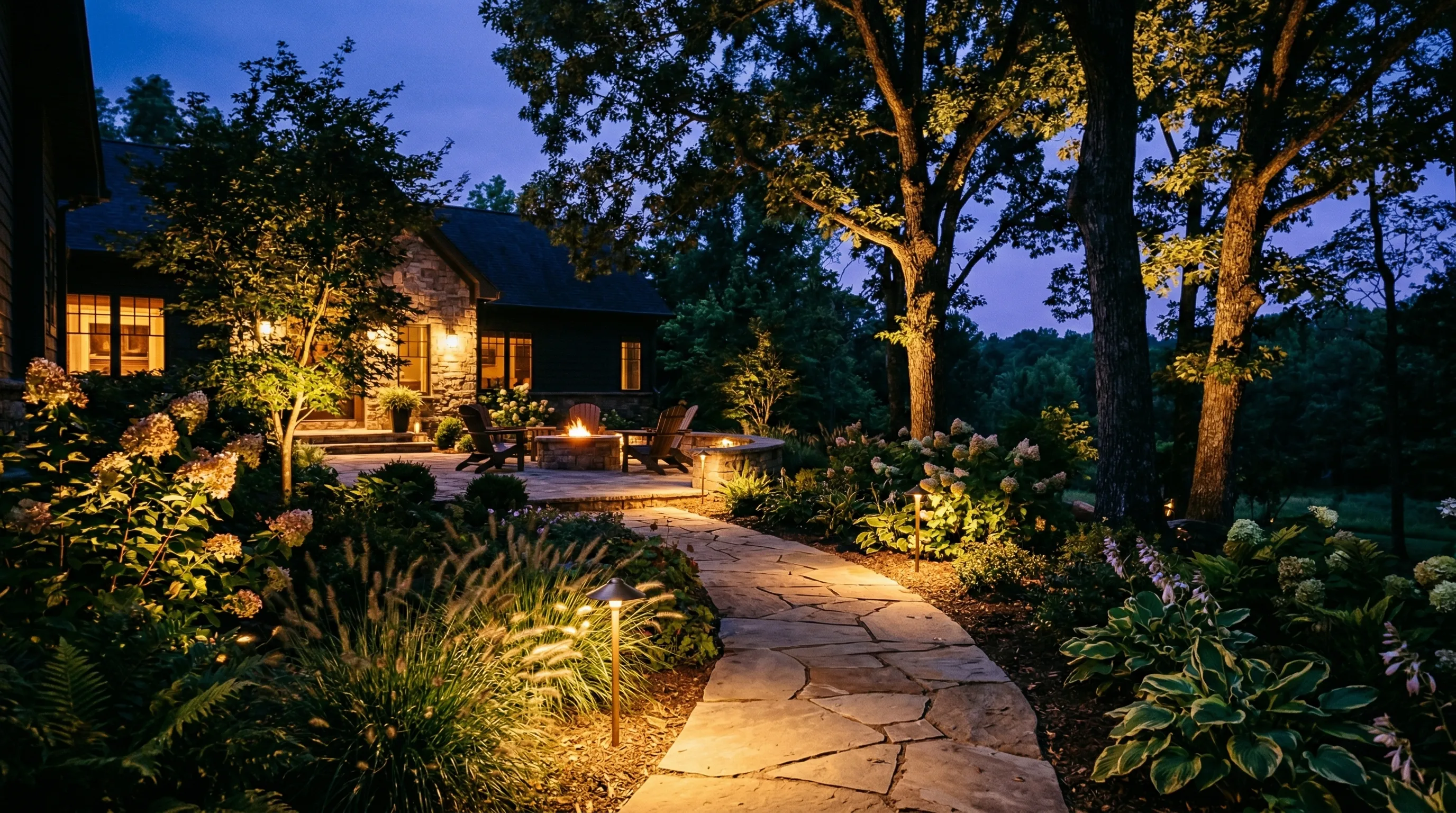
The best landscape lighting ideas share one thing in common: restraint. A well-lit property is not a bright property. It is a property where light draws your eye exactly where the designer intended — to the texture of a stone wall, the canopy of a red maple, the edge of a path — and leaves everything else in shadow.
After three decades of designing and installing lighting systems across Knoxville and East Tennessee, that principle guides every project we take on at Stuart Row Landscapes. Below, we break down the landscape lighting ideas that consistently deliver the biggest impact, the fixtures and techniques behind them, and the design thinking that separates a forgettable installation from one that genuinely changes how you experience your outdoor space.
Start With What Deserves to Be Seen
Before picking fixtures or scrolling through outdoor lighting ideas online, walk your property at night. Turn off the porch light. Let your eyes adjust. Look at your house, your trees, your garden beds, your hardscape. Ask yourself: what is worth highlighting?
This is where landscape lighting design begins — not with a product catalog, but with your property’s best features. Every yard has focal points. The goal is to reveal them.
Common focal points we light on Knoxville properties:
- Specimen trees — East Tennessee is full of them. Mature oaks, maples, dogwoods, and magnolias take on entirely new character when lit from below.
- Stone and masonry — retaining walls, chimneys, column bases. Stone absorbs and reflects light differently than any other material, and it looks spectacular at night.
- Water features — a pond, fountain, or stream that disappears after sunset is a missed opportunity.
- Architectural details — your home’s entry, gable ends, covered porches, and outdoor structures.
- Garden beds — perennial borders and foundation plantings gain depth and dimension with low, warm light.
Once you know what deserves attention, the fixture choices become obvious.
Uplighting: The Single Most Dramatic Technique
If you only do one thing, uplight your trees. Uplighting is the most impactful landscape lighting idea you can execute, and it is straightforward to get right.
How It Works
A directional fixture is placed at the base of a tree or structure and aimed upward. The light grazes the trunk, catches the branch structure, and illuminates the canopy from within. The effect is dramatic, sculptural, and immediately elevates the entire property.
Fixture and Placement Details
- Fixture type: Adjustable-angle LED spot or bullet light, typically 3W to 9W per fixture
- Color temperature: 2700K warm white. This is non-negotiable for residential landscape lighting — anything above 3000K starts looking cold and commercial.
- Placement: 6 to 12 inches from the trunk base, angled between 45 and 80 degrees depending on canopy height. Taller trees need a steeper angle and more wattage. A 60-foot oak may need two or three fixtures to fill the canopy; a 15-foot Japanese maple needs one at low power.
- Spacing for multiple fixtures: When using two or more uplights on a single tree, offset them around the trunk. Lighting from a single direction creates flat shadows. Two fixtures at roughly 120 degrees apart create depth.
Uplighting also works on stone columns, chimneys, and large boulders. Anywhere you want to emphasize vertical texture and height, an uplight is the answer.
Path Lighting: Function First, Then Beauty
Path lighting is the most practical category of outdoor lighting ideas. It keeps people safe walking through your landscape after dark. But practical does not have to mean boring.
Getting Path Lights Right
The most common mistake with path lighting is spacing fixtures too close together and using lights that are too bright. The result looks like an airport runway, not a garden path.
Better approach:
- Spacing: 8 to 10 feet apart on straight runs. Tighten to 6 feet at curves, steps, or grade changes where footing matters.
- Height: Fixtures between 14 and 18 inches tall. The light should fall on the path surface, not shine into eyes at walking height.
- Wattage: 1W to 3W LED per fixture. Path lights do not need to be bright. They need to define edges and changes in elevation.
- Fixture style: Hat-style or mushroom path lights with a downward-facing lens that conceals the light source. You should see the pool of light on the ground, not the bulb itself.
Position path lights on alternating sides of the walkway rather than in matched pairs. Staggered placement creates a more natural rhythm and avoids the runway effect.
Where Path Lighting Matters Most
- Front entry walkways
- Steps and grade transitions (this is a safety issue, not just aesthetics)
- Garden paths through planting beds
- Connections between outdoor living areas — patio to fire pit, deck to garden
Accent Lighting: The Details That Make the Design
Accent lighting is the broadest category, and it is where landscape lighting design gets interesting. These are the smaller, more targeted fixtures that add layers and depth to the overall composition.
Wall Wash and Graze Lighting
A fixture placed close to a textured wall (stone, brick, stucco) and aimed parallel to the surface creates a “graze” effect that emphasizes every joint, shadow, and surface variation. Pull the fixture farther back and you get a softer wash. Both techniques make vertical surfaces come alive.
- Fixture type: Small LED flood or wall wash, 3W to 7W
- Distance from wall: 6 to 12 inches for graze, 24 to 36 inches for wash
- Application: Retaining walls, garden walls, house facades, outdoor fireplace surrounds
Downlighting and Moonlighting
Mounting a fixture high in a tree and aiming it downward mimics the effect of moonlight filtering through branches. The result is soft, dappled light on the ground below — ideal for patios, seating areas, and garden spaces where you want ambient light without visible fixtures.
- Fixture type: Broad-beam LED downlight, 3W to 7W, mounted 15 to 25 feet up
- Mounting: Secured to a major limb with a strap mount that accommodates tree growth
- Best for: Large canopy trees (oaks, maples) positioned over entertaining areas, walkways, or garden rooms
This technique pairs perfectly with uplighting on the same tree. The uplight illuminates the canopy structure; the downlight creates usable ambient light below.
Hardscape and Step Lighting
Integrated lights built into walls, steps, seat walls, and pillar caps. These are small (typically 1W to 2W LED), recessed or surface-mounted, and designed to be nearly invisible during the day.
- Step risers: a small recessed light in every second or third riser prevents trips and adds a subtle glow to patios and terraces
- Seat wall caps: a low-output fixture in the top of a pillar or wall cap marks the edge of a structure
- Under-cap lights on columns and posts: downward-facing fixtures that wash the column surface below
LED Landscape Lighting: Why It Is the Only Option
Every system we install at Stuart Row uses LED landscape lighting exclusively. This is not a preference — it is a technical decision based on performance.
Why LED:
- Energy use: An LED fixture drawing 3W produces as much usable light as a 20W halogen. A full-property lighting system of 25 to 40 LED fixtures typically runs on a single 300W to 600W transformer.
- Lifespan: Quality LED fixtures last 40,000 to 50,000 hours. That is over 15 years of nightly use at 8 hours per night.
- Heat: LEDs produce almost no heat at the fixture. This matters when fixtures are placed near plants, mulch, and root zones.
- Color consistency: Modern LEDs hold their color temperature over their lifespan. Halogen bulbs shift yellow as they age.
- Dimming and control: LED systems integrate cleanly with timers, photocells, Wi-Fi controllers, and zone dimmers.
The low-voltage (12V) transformer is the heart of the system. We size transformers to handle the total connected load plus 20 to 30 percent headroom for future expansion. All wiring is direct-burial rated with waterproof connections at every splice.
Designing Your Lighting Plan: Layering Is Everything
The best landscape lighting design uses three layers working together:
- Task lighting — path lights, step lights, and any fixture whose primary job is safety and navigation
- Accent lighting — uplights, spotlights, wall washes, and focal-point fixtures that highlight specific features
- Ambient lighting — downlights, moonlights, and soft area washes that provide overall atmosphere
A property with only task lighting feels institutional. A property with only accent lighting feels like a stage set. The combination — practical light where you walk, dramatic light on focal points, and soft fill light where you gather — creates a landscape that feels complete after dark.
This layered approach is the same philosophy we apply to landscape design in general. Every element serves a purpose, and the elements work together.
Putting It Into Practice
If you are exploring landscape lighting ideas for your own property, here is where to start:
- Walk the property at night. Identify what you want to see and where you need safe footing.
- Pick your focal points. Two to four well-lit features are better than ten poorly lit ones.
- Think in layers. Combine path lighting, uplighting, and at least one ambient technique.
- Stay warm. 2700K to 3000K color temperature, always. Your East Tennessee landscape will thank you.
- Plan for control. Zones, timers, and dimmers let you adjust the mood — bright for a party, soft for a Tuesday evening on the patio.
- Use quality fixtures. Brass and copper bodies outlast painted aluminum by decades. The upfront cost is higher; the long-term cost is lower.
Let Stuart Row Design Your Lighting
We have been designing landscape lighting systems in Knoxville since 1995. We know which trees on your street look best lit from below, how the evening light shifts across a West Knoxville hillside, and exactly how much light a flagstone patio needs for dinner outside without overpowering the fireflies in June.
If you are ready to see your landscape after dark the way it was meant to be seen, get in touch. We will start with a nighttime visit to your property and build a lighting plan from there.
Written by
Stuart Row Landscapes
Boutique landscape design & installation in Knoxville, TN since 1995. Over 30 years of experience designing outdoor spaces across East Tennessee.
Ready to bring these ideas to life?
Stuart Row Landscapes has been turning inspiration into reality across Knoxville and East Tennessee for over 30 years.
Start a Conversation