The Complete Guide to Backyard Water Features
Everything you need to know about choosing, designing, and building a backyard water feature — from ponds and waterfalls to fountains and streams — with specific guidance for Knoxville and East Tennessee properties.
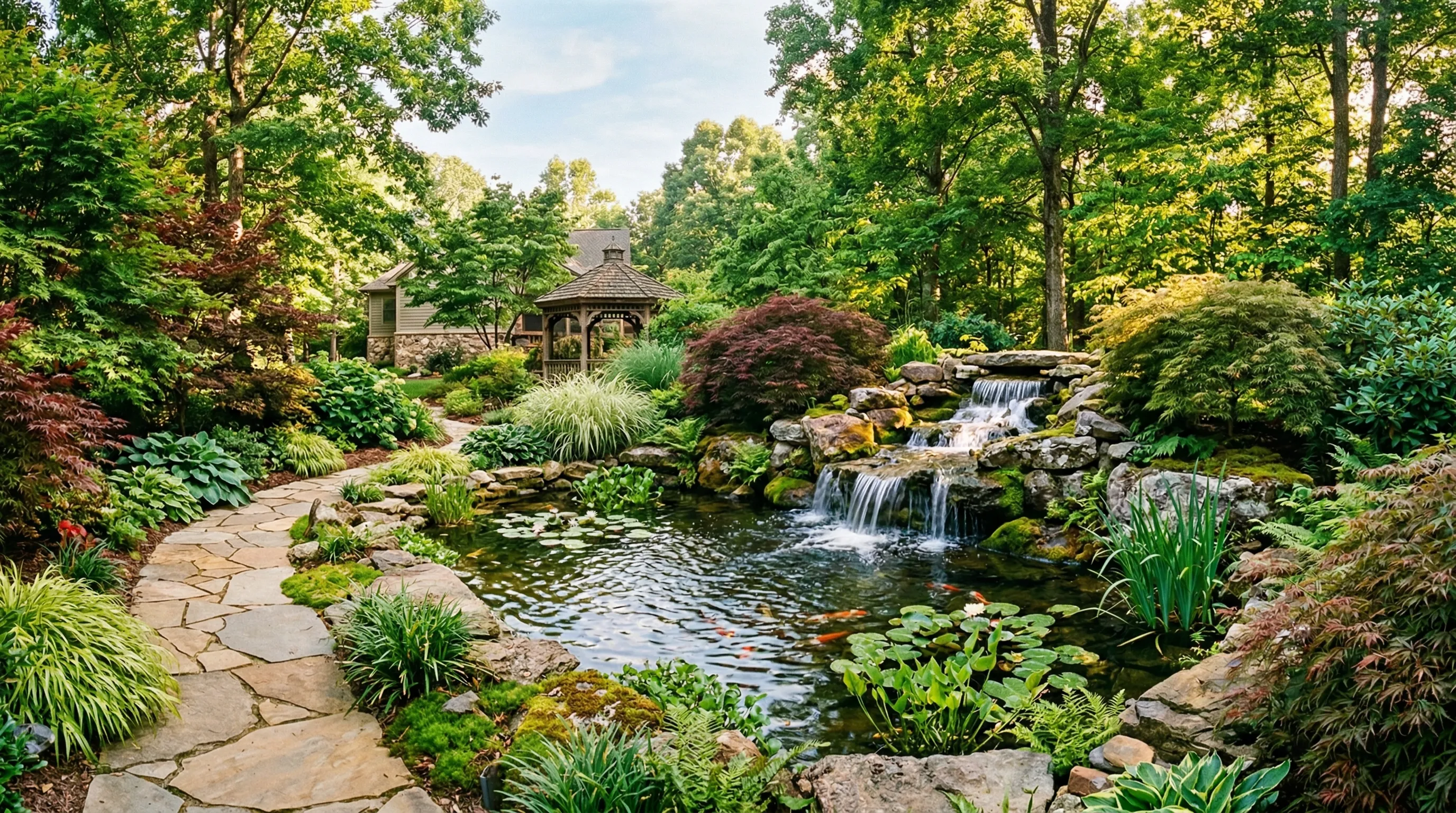
A backyard water feature is the single most impactful element you can add to an outdoor space. Nothing else changes the atmosphere of a yard so immediately — the sound, the movement, the way light plays across the surface. After 30 years of designing and building water features across East Tennessee, we can say that without hesitation.
But “water feature” is a broad term, and the right one for your property depends on your space, your budget, your maintenance tolerance, and — frankly — what kind of experience you want when you step outside. This guide covers all of it.
Types of Backyard Water Features
Not every water feature involves a pond, and not every yard needs a waterfall. Here are the main categories, along with what each one actually requires.
Waterfalls
A waterfall is the most dramatic backyard water feature you can build. It delivers both visual impact and sound — the kind of white-noise backdrop that drowns out traffic, neighbors, and the general hum of suburban life.
Natural waterfalls are built from stacked stone (we use Tennessee fieldstone and local moss rock almost exclusively) with water recirculated by a submersible pump. The height and width of each cascade determines the sound — a narrow, tall fall produces a sharper tone, while a wide, shallow shelf creates a softer rush. We tune this during the design process so the result sounds intentional, not like a broken pipe.
A typical residential waterfall system uses a 3,000-6,000 GPH pump, EPDM rubber liner, underlayment fabric, and a biological filter or skimmer at the basin. Expect the pump to draw 200-400 watts — roughly the same as a few light bulbs running continuously.
Ponds
A pond introduces an entirely different dimension: stillness. Where a waterfall is about energy, a pond is about depth — reflections, aquatic plants, fish, the slow rhythm of an ecosystem finding its balance.
Koi ponds need a minimum of 1,000 gallons and at least 3 feet of depth to overwinter fish in Knoxville’s climate (USDA Zone 7a). Ecosystem ponds — with bog filtration, submerged plants, and natural bacteria colonies — require far less chemical intervention than people expect. A well-balanced pond largely takes care of itself.
For homeowners who love the look of a pond but have small children or just want less commitment, a pondless waterfall is the answer. Water cascades over stone and disappears into a hidden underground reservoir. All the beauty, none of the open water.
Fountains
Fountains are the most versatile backyard water feature — they fit courtyards, patios, entries, and tight side yards where a full waterfall would be out of scale. Options range from a single bubbling boulder (literally a drilled stone with a recirculating pump beneath it) to formal tiered or wall-mounted fountains with architectural presence.
A bubbling rock or urn fountain can be installed in a weekend and runs on a small 300-800 GPH pump. It is the lowest-maintenance water feature you can own.
Streams
A stream is a water feature that moves through a landscape rather than sitting in one spot. A well-designed stream meanders — following the natural grade of the land, pooling in shallow eddies, narrowing over gravel bars, widening around planted banks. It should look like it has always been there.
Streams work exceptionally well in East Tennessee because the terrain gives them to us naturally. Many Knoxville properties have enough grade change that gravity does most of the visual work. We route streams through existing plantings, along fence lines, or from an upper waterfall down to a lower pond — connecting different zones of the yard into a single, cohesive experience.
Designing a Backyard Water Feature That Lasts
The difference between a water feature that looks right and one that looks like a plastic tub buried in the yard comes down to three things: placement, materials, and integration with the surrounding landscape.
Placement
Put the water feature where you will actually experience it. That sounds obvious, but we see it done wrong constantly — a pond tucked into a far corner of the yard where nobody sits, a waterfall facing away from the patio, a fountain hidden behind a shed.
Consider these factors:
- Sight lines from the house. You should see the water feature from your kitchen window, your living room, or wherever you spend the most time. The visual connection matters even when you are inside.
- Proximity to seating. The sound of moving water drops off quickly with distance. If you want to hear your waterfall from the patio, it needs to be within 25-30 feet, depending on the volume of the falls.
- Tree canopy and leaf load. Water features near deciduous trees will need more skimming and cleaning. We factor this into every landscape design — sometimes we are choosing between the perfect visual spot and the practical one.
- Sun exposure. Full sun promotes algae growth in ponds. Partial shade (4-6 hours of direct sun) is ideal for most water features with aquatic plants.
Materials That Belong Here
We build almost exclusively with natural stone sourced from East Tennessee quarries. Tennessee fieldstone, river rock, and weathered limestone all belong in this landscape — they match the geological character of the Smokies and the Ridge-and-Valley terrain around Knoxville. Manufactured stone or imported flagstone can look fine in isolation but rarely feels right next to a stream or waterfall.
For liners, we use 45-mil EPDM rubber — not PVC. EPDM is flexible enough to conform to irregular shapes, resistant to UV degradation, and carries a 20+ year lifespan. PVC liners get brittle in our freeze-thaw cycles and crack within a few years. The cost difference is marginal; the performance difference is enormous.
Plumbing is schedule 40 PVC with check valves at every pump. Fittings are glued, not friction-fit. We over-size pipe diameter to reduce head pressure and extend pump life. These are the details that determine whether your water feature is still running smoothly in 15 years or leaking into the subgrade.
Working With East Tennessee’s Climate and Soil
Knoxville gets roughly 47 inches of rain per year — enough to keep water features naturally topped off during spring and summer, but also enough to cause problems if drainage is not handled correctly.
Clay soil is the big one. Most properties in Knox County sit on heavy clay that drains poorly. If you dig a hole for a pond in clay soil without accounting for hydrostatic pressure, groundwater can push the liner up from below during heavy rains. We use relief valves and gravel drainage beds beneath liners to prevent this. It is not complicated, but it is the kind of detail that gets skipped by installers who do not build water features regularly.
Winter is mild enough that most water features in Knoxville can run year-round. We recommend a small floating de-icer for koi ponds during the handful of hard freezes we get in January and February, but waterfalls and streams generally do fine with continuous circulation. Moving water does not freeze easily.
Aquatic Plants for Knoxville Water Features
Plants are what turn a water feature from a construction project into a living system. For ponds and stream edges in East Tennessee, we favor a mix of native and well-adapted species:
- Marginals (shallow edges): Blue flag iris (Iris virginica), pickerelweed (Pontederia cordata), cardinal flower (Lobelia cardinalis), soft rush (Juncus effusus)
- Floating/submerged: Water lilies (Nymphaea spp. — hardy varieties for Zone 7a), hornwort (Ceratophyllum demersum) for oxygenation, water lettuce for surface shade
- Streamside plantings: Cinnamon fern (Osmunda cinnamomea), Japanese forest grass, native sedges, and astilbe along the banks to soften stone edges
The plantings around a water feature matter as much as the plantings in it. A waterfall surrounded by mulch and boxwoods does not read as natural. Layered ferns, mosses, and groundcovers growing into the crevices between boulders — that is what makes a water feature look like it belongs.
Backyard Water Feature Ideas by Budget
Here is a realistic breakdown of what different types of water features involve, from entry-level to full-scale installations:
- Bubbling boulder or urn fountain — A single drilled stone or decorative vessel on a hidden reservoir. Minimal footprint, minimal maintenance, maximum sound-per-dollar. Great for patios, courtyards, and entryways.
- Pondless waterfall — A 3-5 foot cascading waterfall that disappears into an underground basin. All the drama of a waterfall without the open water of a pond. Popular with families.
- Stream and waterfall combination — A waterfall feeding into a 10-20 foot meandering stream. This is where hardscaping and water feature design start to overlap — stone pathways, stream crossings, and planted banks create a complete garden experience.
- Full ecosystem pond with waterfall — A pond (1,000-3,000+ gallons), cascading waterfall, biological filtration, aquatic plantings, and often landscape lighting. This is the flagship backyard water feature — the centerpiece of the entire property.
Every project is different, and the right scope depends on your property, your goals, and how you want to use the space. We walk every site before we quote anything.
Common Mistakes We See
After three decades, the patterns are clear. These are the backyard water feature mistakes that come up over and over:
- Undersized pumps. A pump that cannot turn over the full volume of water at least once per hour will produce stagnant zones, algae, and murky water. Bigger is almost always better.
- No edge treatment. The liner edge is the most visible failure point. If you can see rubber or plastic at the waterline, the illusion is broken. We bury liner edges under stone and plant into the seams.
- Ignoring sound design. Two waterfalls of the same height can sound completely different depending on the stone configuration. Sound should be designed, not left to chance.
- Skipping biological filtration. Mechanical filters alone are not enough for ponds. You need a biological filter or bog system where beneficial bacteria can colonize and break down ammonia and nitrites.
- Flat placement. Water features built on dead-flat ground always look forced. Even a slight grade change — 12 to 18 inches — gives a waterfall or stream the visual context it needs.
Why Work With a Water Feature Specialist
Water features sit at the intersection of plumbing, electrical, ecology, horticulture, and stone masonry. A general landscaper can plant beds and lay pavers. A water feature specialist understands head pressure calculations, bio-load capacity, seasonal pump cycling, and how to place a 400-pound boulder so it looks like it has been sitting there since the last ice age.
Stuart Row Landscapes has focused on water feature design and installation since 1995. It is the work we are best known for in Knoxville, and the work we enjoy most. Every water feature we build is designed as an integrated part of the larger landscape — connected to the plantings, the stone, the grade, and the way light moves across the property throughout the day.
Start the Conversation
If you have been thinking about a backyard water feature — whether it is a simple fountain on the patio or a waterfall-and-pond system that transforms your entire yard — we would like to hear about it. We start every project with a site visit and an honest conversation about what is realistic for your property, your budget, and your vision.
Get in touch with Stuart Row Landscapes to schedule a consultation. We have been doing this for 30 years, and we are not tired of it yet.
Written by
Stuart Row Landscapes
Boutique landscape design & installation in Knoxville, TN since 1995. Over 30 years of experience designing outdoor spaces across East Tennessee.
Ready to bring these ideas to life?
Stuart Row Landscapes has been turning inspiration into reality across Knoxville and East Tennessee for over 30 years.
Start a Conversation